

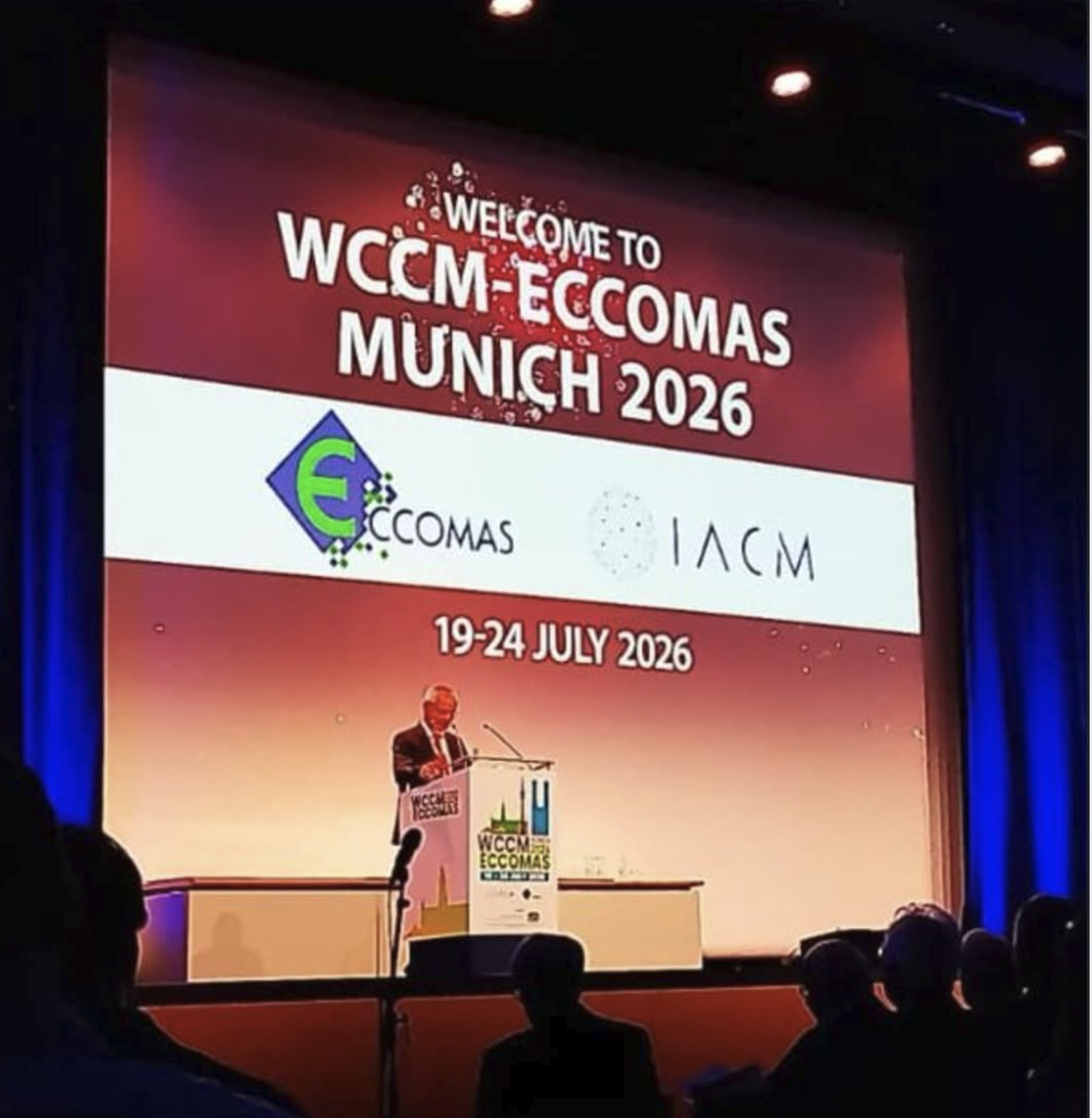
At the WCCM–ECCOMAS 2026 conference in Munich, a new research contribution explored the potential of combining high-fidelity computational fluid dynamics, advanced mesh morphing techniques, and artificial intelligence to accelerate the design and analysis of ship hulls.
The paper, “A GPU-Accelerated AI-based Tools Framework for CFD-Based Ship Hull Design”, was presented within the Special Technology Session STS424B – Integrating AI and Fluid Dynamics II and is the result of a collaboration between ENGYS, NVIDIA, RBF Morph, and the University of Rome Tor Vergata.
The work presents a proof-of-concept numerical workflow aimed at enabling faster and more efficient ship hull design and resistance prediction. The proposed methodology integrates three key technologies: validated CFD simulations, RBF-based mesh morphing for efficient geometry parametrization, and GPU-accelerated artificial intelligence models.
A central element of the approach is the use of RBF mesh morphing to generate large families of geometrically consistent hull variants starting from a reference configuration. This enables the creation of extensive training datasets while preserving mesh quality and avoiding the need for costly remeshing operations. The resulting geometrical flexibility provides an effective foundation for AI-based modelling strategies in complex engineering applications.
The CFD database used for the study was generated using ENGYS’ open-source CFD technology, based on Reynolds-averaged Navier–Stokes simulations with a linearized free-surface model, applied to the well-established KRISO Container Ship hull benchmark. The generated flow solutions were then used to train an AI surrogate model based on NVIDIA PhysicsNeMo, enabling rapid prediction of flow-related quantities, including hull deformation effects, pressure and shear stress distributions, and calm-water resistance.
The results demonstrate the potential of hybrid physics-based and data-driven approaches for naval hydrodynamics, with the AI model achieving prediction errors below 1% for unseen configurations. This highlights how the combination of accurate simulation, advanced geometry manipulation, and artificial intelligence can provide a foundation for future digital twin solutions in the marine sector.
Developed within the Italian AI4TwinShip initiative, this research represents a further step towards the adoption of intelligent computational methods for engineering design, extending approaches already successfully applied in sectors such as automotive and aerospace to the challenges of ship design and optimisation.
The presentation was delivered by Emiliano Costa (ENGYS) on behalf of the authors: Emiliano Costa, Benedetto Di Paolo, Apostolos Krassas, Paolo Geremia (ENGYS); John Linford, Neil Ashton, Ian Pegler, Rishi Ranade, Abouzar Ghasemi (NVIDIA); Massimiliano Machowski (RBF Morph); and Marco Evangelos Biancolini (University of Rome Tor Vergata).