

Published in the new Springer volume Digital Twins for Aerospace, edited by Marco Biancolini, Corrado Groth, and Ubaldo Cella, this contribution presents a workflow for aero-structural shape optimization based on high-fidelity Fluid-Structure Interaction (FSI) analysis.
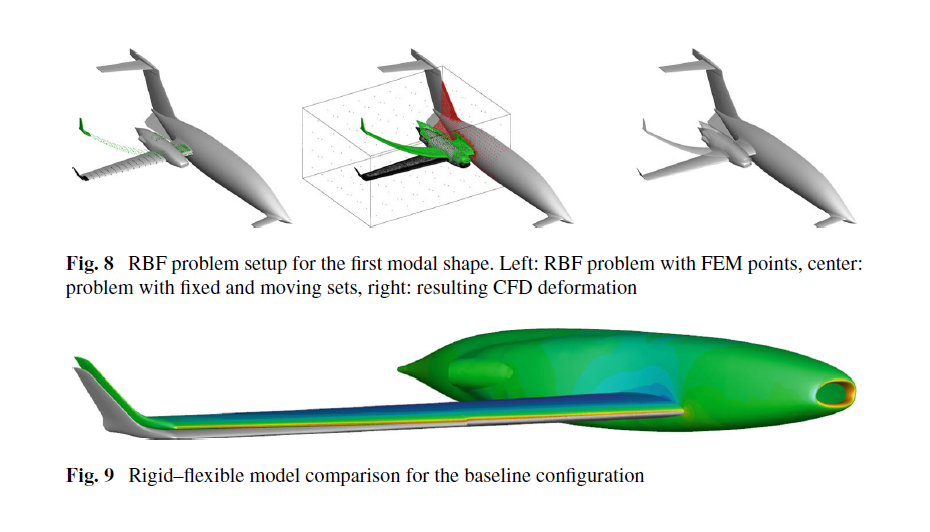
The study focuses on the optimization of aircraft winglets by integrating aerodynamic simulations with structural flexibility effects. A dedicated FSI workflow is developed for non-matching Computational Fluid Dynamics (CFD) and Computational Structural Mechanics (CSM) meshes, combining structural modal reduction techniques with Radial Basis Function (RBF) mesh morphing methods. The proposed approach enables accurate deformation transfer and mapping across models with different levels of fidelity.
The methodology is demonstrated on an industrial case study involving the winglet of the Piaggio Aerospace P180 Avanti EVO aircraft. The workflow couples a hybrid Finite Element Analysis (FEA) structural model — including beam elements for the nacelle, shell elements for the wing box, and solid elements for the winglet — with a high-fidelity CFD model to support aeroelastic simulations and shape optimization activities.
The work highlights how advanced Digital Twin methodologies can support multidisciplinary aircraft design processes by improving the integration between aerodynamic and structural analyses in industrial environments.
Read the full chapter: https://link.springer.com/chapter/10.1007/978-3-032-05022-9_7