

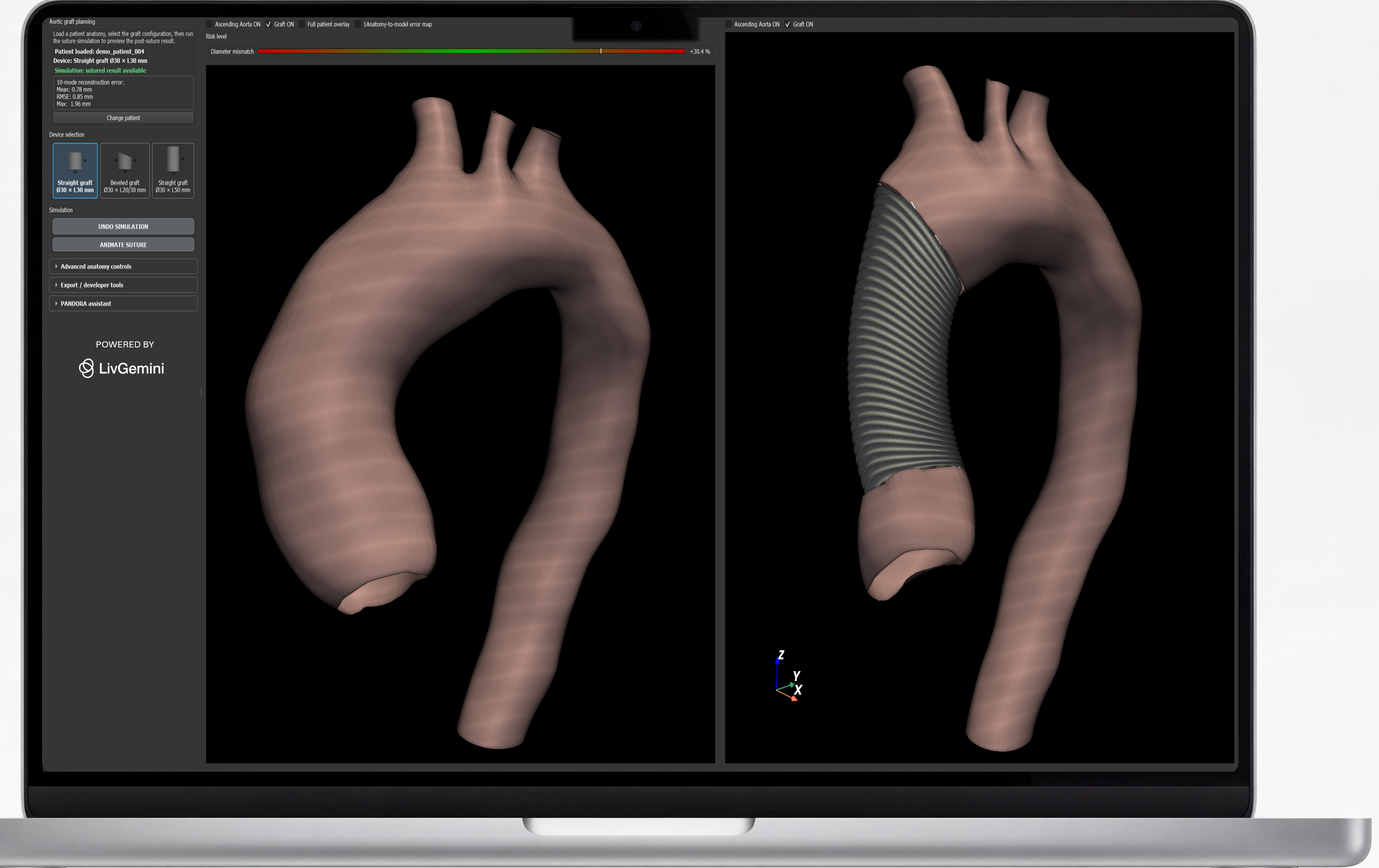
After months of innovation, collaboration, and large-scale computation, the European PANDORA project has officially reached its conclusion and the results demonstrate the transformative power of combining High-Performance Computing (HPC), Artificial Intelligence, Digital Twins, and advanced simulation.
PANDORA addressed a critical challenge in vascular surgery: the need for patient-specific pre-operative planning for aortic graft procedures. Today, nearly 20% of these interventions require secondary procedures due to suboptimal graft adaptation. While high-fidelity biomechanical simulations can predict surgical outcomes, their computational cost has historically prevented routine clinical adoption.
The PANDORA consortium – LivGemini, RBF Morph, Université de Rennes, and INSA – successfully bridged this gap by creating a Digital Twin-driven planning assistant capable of predicting graft adaptation in near real time.
The numbers behind the project tell a remarkable engineering story:
- 73 patient-specific aortic anatomies processed to build a Statistical Shape Model
- 2,000 synthetic anatomies generated through AI-driven sampling
- 256 representative anatomies selected for high-fidelity analysis
- More than 500 nonlinear LS-DYNA simulations executed on the Leonardo supercomputer
- Approximately 900,000 CPU core-hours consumed during the simulation campaign
By leveraging Europe’s world-class HPC infrastructure, the consortium transformed massive simulation datasets into Reduced Order Models integrated into an interactive software platform deployable on standard hospital computers without requiring local HPC resources.
The platform leverages the Functional Mock-up Interface (FMI) standard for model exchange and co-simulation. By encapsulating simulation models as Functional Mock-up Units (FMUs), the platform enables seamless integration of Digital Twin components across different software environments, simplifies deployment, encourages model reuse, and reduces vendor lock-in. This standards-based approach makes it easier to extend the platform with new physiological models, connect with clinical software ecosystems, and accelerate the translation of research innovations into routine clinical practice.
What makes PANDORA particularly significant for engineers and technology leaders is its successful integration of HPC, AI, Reduced Order Models, and Digital Twins into a single operational workflow. The project demonstrates how advanced simulation technologies can move beyond research environments and become practical decision-support tools with real-world impact.
The result is a scalable solution capable of improving surgical planning, reducing healthcare costs, supporting better patient outcomes, and strengthening European leadership in Digital Health and AI-enabled Digital Twins.
A special thank you to our partners: CINECA, providing access to the Leonardo supercomputer and HPC expertise, and ANSYS, enabling advanced simulation technologies and workflows.